





The crypto licensing world in 2026 looks nothing like it did three years ago. Back then, a company could pick Lithuania, submit some basic paperwork, and wait. Now, regulators ask about your transaction monitoring software before they even look at your business plan. They want to meet your compliance officer. They request proof of real infrastructure.
The firms that handle this work have changed, too. General business lawyers who dabbled in crypto on the side are mostly gone. In their place are legal consultants for crypto licensing who do nothing else day in and day out.
These four firms do nothing but crypto licensing. That is all they handle day after day. Some piece together regulatory structures across three or four countries at once. Others zero in on one jurisdiction and know every officer at the regulator by name.
Your pick comes down to your expansion plans and whether you want someone who disappears after approval or stays for the follow-up work.
Quick Comparison
The table below lays out where each crypto license service provider operates and what they specialize in.
| Firm | Jurisdictions | Key Strength | Best For |
| Gofaizen & Sherle | 50+ worldwide (US, EU, UAE, Asia, LatAm, Canada) | End-to-end licensing plus post-license compliance | Crypto exchanges needing multi-jurisdiction support |
| Stalirov & Co | US, EU, UAE, Asia | US MSB + MTL licensing, fintech integrations | US-focused projects expanding internationally |
| COREDO | EU, Singapore, UAE, Canada | Jurisdiction selection methodology, AML implementation | Structured, data-driven licensing approach |
| Manimama | EU, Canada, UAE, Switzerland | Crypto-only practice, strong MiCA expertise | European crypto projects targeting EU markets |
Each firm takes a different path to getting projects approved. Here is what sets them apart.
1. Gofaizen & Sherle
Gofaizen & Sherle is a legal service to obtain a crypto license, offering end-to-end support for crypto exchanges, custodial services, tokenization platforms, and DeFi projects. Their team handles jurisdiction selection, regulatory structuring, and post-license compliance across more than 50 jurisdictions worldwide.
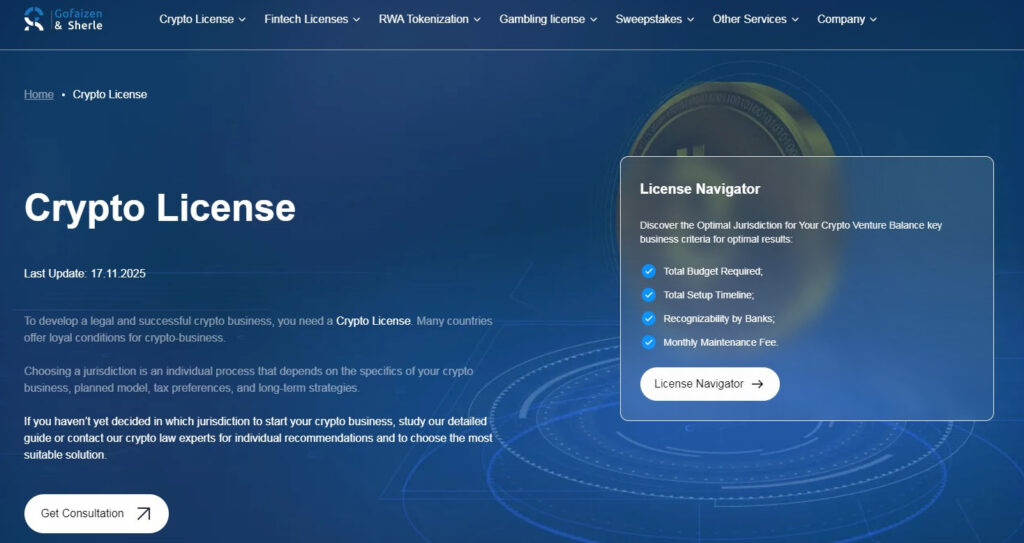
The firm has completed licensing projects across crypto, tokenization, and fintech at a scale few others have reached. Those projects stretched across Europe, North America, Latin America, and Asia. An office opened in El Salvador in 2024. The following year brought expansion into the US, Canada, South Africa, Brazil, and Mexico.
Their lawyers for obtaining a crypto license offer a full range of services:
- Company formation and capital structuring in selected jurisdictions
- Crypto exchange, custody, and VASP licensing across Europe, the Americas, and Asia
- AML/KYC policy drafting and compliance program implementation
- Regulatory negotiations with FINTRAC (Canada), CNAD (El Salvador), and other authorities
- Banking infrastructure setup and payment provider integration
- Local talent recruitment for compliance officer and MLRO positions
- Post-license compliance support, reporting, and regulatory updates
The firm built an in-house tool called Crypto License Navigator that launched in November 2025. It helps crypto businesses compare licensing options by looking at minimum capital requirements, corporate tax rates, licensing timelines, bank accessibility, and each jurisdiction’s reputation.
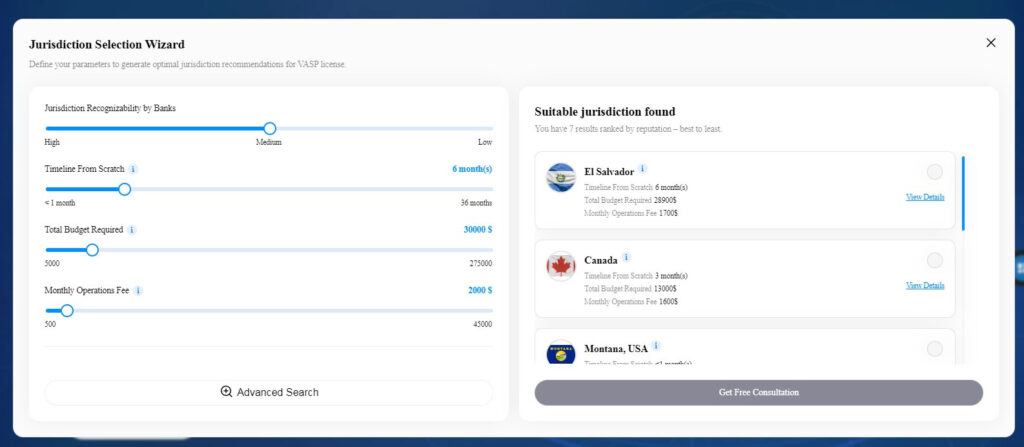
Gofaizen & Sherle experts recommend running your business model through the Navigator before talking to any regulator. The tool returns jurisdictions that match your specific budget and service scope instead of a generic list.
The firm operates physical offices in Estonia, Lithuania, Poland, Germany, Czech Republic, Canada, Dubai, Hong Kong, and El Salvador. One client noted in a Trustpilot review that the firm “promptly delivered clear guidance on regulatory compliance and contract negotiations,” with “responsiveness, attention to detail, and ability to navigate intricate legal challenges.”
Another client mentioned working with the firm across multiple jurisdictions for crypto-related matters, noting their “excellent understanding of the market and regulatory requirements.” A third client highlighted their after-sales support, saying the team set up a dedicated follow-up group and handled post-license queries with “incredible speed and attention.”
Best for: A specialized legal firm for obtaining crypto license that fits crypto exchanges, custodial services, tokenization platforms, and DeFi projects needing multi-jurisdiction support with a single point of contact across Europe, the Americas, and Asia.
2. Stalirov & Co
Stalirov & Co provides legal crypto consulting designed to launch and scale crypto businesses, with deep expertise in the US, EU, and other key jurisdictions. Their team handles Money Services Business registration with FinCEN and secures state Money Transmitter Licenses across the US.
The firm provided ongoing legal support for Intellabridge, a publicly traded fintech company based in Colorado that operates on the Canadian Securities Exchange, OTC Markets in the US, and the Frankfurt Börse in Europe.
Stalirov & Co’s team prepared legal opinions covering four key regions:
- Germany, where they structured integration with Solarisbank, a German banking license holder;
- The UAE, covering commercial licensing and free zone requirements;
- Canada, addressing FINTRAC, CSA, and IIROC regulations;
- The US, handling CFTC, FTC, SEC, and FinCEN requirements for integration with Prime Trust.
The lawyers concluded that Intellabridge did not need to register as a Money Services Business or obtain a license in the US. They also developed the Privacy Policy and Terms of Use for the Kash platform and supported team onboarding and offboarding.
Their lawyers for obtaining a crypto license offer a full range of services:
- Company formation in favorable jurisdictions
- Crypto exchange and custody licenses in Estonia, Malta, and the UAE
- AML/KYC compliance programs
- Regulatory compliance with SEC, FINRA, CFTC, FinCEN, and FATCA requirements
- Tax consulting and IRS guidance
- GDPR/CCPA compliance
- NFT project launch support
They operate from offices in Princeton, New Jersey, serving clients across the US and international markets.
The firm’s US focus makes them particularly valuable for projects that need to navigate the complex two-tier system of federal MSB registration and state MTL licensing. They bridge the gap between US requirements and international expansion.
Best for: US-based crypto projects or international firms targeting the American market.
3. COREDO
COREDO is an EU legal and compliance firm based in Prague, specializing in financial licensing, including CASP under MiCA, EMI, PSP, and MSB registration. Since 2016, the COREDO team has implemented dozens of projects in the EU, Singapore, Dubai, the United Kingdom, Estonia, Cyprus, the Czech Republic, Slovakia, and Canada.

Their jurisdiction selection matrix ranks countries across six blocks:
- Regulatory regime
- Cost and timelines
- Substance requirements
- Banking ecosystem
- Tax predictability
- Sanctions and reputational risks
For crypto projects, they implement crypto AML controls:
- PEP screening
- OFAC and international sanction lists
- EU sanctions screening
- KYT with case management for SARs and investigations
COREDO’s practice covers MSB registration in Canada through FINTRAC, which typically takes three to four months with ready policies and IT controls. They also handle VASP registration in Estonia with enhanced requirements, including:
- Local office
- Board
- Real substance
- Minimum authorized capital
- Appointment of MLRO and compliance officer
Their AML programs follow FATF standards, EU rules, and local requirements. They plug in AML software and regulatory technology tools to keep monitoring running without manual work.
The firm recently published an analysis on EU financial regulation for 2026, noting that more than 60 new directives and regulations related to financial regulation, AML, and digitalization will be in force across the EU. According to EBA data, fines for AML violations increased by 38% in 2025 compared to the previous period.
Best for: Clients who want jurisdiction selection based on actual data and need legal service to obtain a crypto license with technical compliance systems that regulators actually accept.
4. Manimama
Manimama works exclusively with crypto companies. Exchanges, wallet providers, token projects. That is their client list. They handle licensing in Lithuania, Poland, Cyprus, Malta, Canada, the UAE, and Switzerland.
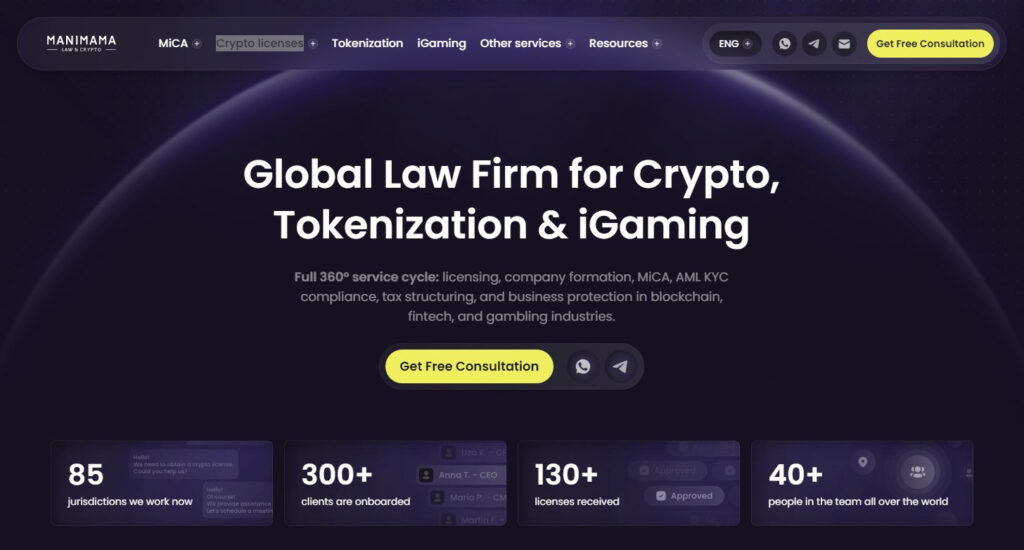
They start with jurisdiction selection. Then company formation and the license application. Then they stick around for compliance support after approval. AML and KYC frameworks get drafted based on how the client actually runs their business and what risks come with that model.
The firm knows the MiCA transition well, helping VASPs switch to CASP status for EU operations. They also work with offshore jurisdictions for clients who prefer lighter regulatory structures.
Manimama’s services include:
- VASP licensing from jurisdiction selection to filing
- Advice on token rules, eligibility, FATF, MiCAR, and AML requirements
- AML/KYC programs covering due diligence, monitoring, and risk documentation
- GDPR compliance policies and data transfer guidance
- Contract drafting for user agreements, AML policies, and licensing documents
- Post-license compliance reviews, reporting, and updates
Because crypto is all they do, their crypto lawyers know the pain points before clients run into them. European licensing expertise paired with reach into Canada, UAE, and Switzerland makes them a good fit for projects looking at the EU market under MiCA.
Best for: Crypto projects based in Europe or international firms wanting entry into EU markets.
What Separates Good Firms from the Rest
Getting a license is table stakes. Every firm on this list can do that. The real difference is what happens six months after approval.
Some firms treat the application as the finish line. Once the license arrives, they vanish. The client is left handling regulator questions alone, scrambling to prepare compliance reports, and figuring out how to renew the license without guidance.
Others treat the application as the starting point. They know regulators will circle back in six months with follow-up questions. They know the MLRO will need ongoing support. They know policies require updates when new FATF recommendations drop.
There is an easy way to separate the ones worth hiring from the ones to skip. Ask them what happens six months after the license arrives. If they can walk you through compliance maintenance, regulatory filings, and renewal timelines, they are planning for the long run. If they hesitate or give vague answers, move on.
A license is not a trophy. It is a contract with a regulator that says you will stay compliant. The firms that understand this build client relationships that last years, not months.
FAQ
The questions below come from what these firms have actually seen happen with regulators over the past year.
What actually changed with MiCA in 2026?
Up until 2026, European crypto firms ran on national VASP registrations. Those no longer exist. Since January 2026, only CASP licenses under MiCA exist. The transitional arrangements expired. Companies still running on old registrations are operating illegally if they have not converted.
What is the difference between a CASP license and an MSB registration?
A CASP license under MiCA covers 10 specific crypto-asset services, including trading platform operation, custody, exchange, and portfolio management. It provides passporting rights across all 27 EU countries. Canada calls it MSB registration. It covers money services businesses that handle virtual currencies. No minimum capital needed, but FINTRAC watches AML compliance closely.
How do I know if my business actually needs a license?
The trigger is often something founders overlook. Holding custody of client funds. Operating a trading platform with order matching. Running a fiat on-ramp or off-ramp. Having administrative control over private keys. If any of these sound like your business, you need a license. Jurisdictions define VASP and CASP activities broadly to catch exactly these scenarios.
What is the fastest jurisdiction for a crypto license in 2026?
El Salvador runs 3 to 6 months for a DASP license. Canada MSB registration takes 3 to 4 months if you have policies ready. Panama and Costa Rica move faster but come with different trade-offs. EU CASP licensing under MiCA runs 6 to 8 months from application to approval, though the clock stops whenever regulators ask for more documents.
Do I need a physical office in every country where I operate?
No. With a CASP license under MiCA, one EU member state covers all 27. No offices needed in each country. El Salvador and Canada let foreign companies operate without a local presence. Dubai and Hong Kong require one.
What are the capital requirements for a CASP license?
The services determine the number. Order execution, advice, and portfolio management run €50,000. Add custody and exchange services, and it goes to €125,000. Running a trading platform costs €150,000.
Conclusion
Every firm here has done this work hundreds of times. They have done this work hundreds of times. They know which regulators push back on certain business models. They know which banks actually open accounts for licensed crypto firms. They know what happens when an audit comes.
But the real difference shows up twelve months after approval. Some firms send a congratulations email and move to the next client. Others schedule the first compliance review before the license even arrives. They know the regulator will circle back. They want the client to be ready.
A license in 2026 comes with ongoing obligations. Quarterly reports. Policy updates. Annual renewals. Compliance officer support. The firms that treat licensing as a subscription rather than a one-time purchase build structures that last.
Match the firm to your expansion plans. Going after multiple regions? Find a partner with offices in those places and a team that passes work between time zones without dropping details. Only need one license in one country? A specialist in that jurisdiction probably fits better.
The paperwork gets filed either way. What matters is who picks up the phone when the regulator calls six months later.